
Building a successful trade Contracting enterprise is a journey defined by distinct operational phases. Many trade entrepreneurs start out as highly skilled technicians, mastering their craft in the field, managing customer relationships directly, and driving a single service vehicle. However, as demand increases, trade business owners inevitably hit an operational ceiling. They find themselves trapped working sixty to eighty hours a week, juggling emergency dispatch calls while attempting to manage invoicing, inventory, and field labor.
Attempting to expand a service business simply by taking on more calls without updating internal operations is one of the fastest ways to trigger business failure. Uncontrolled growth creates severe cash flow crunches, damages customer satisfaction rates, and leads to chronic employee burnout. Sustainable expansion requires a fundamental mindset shift: transitioning from a talented field technician working in the business to a strategic executive working on the business.
To build a enterprise that grows predictably and profitably year after year, business owners must replace ad-hoc daily routines with standardized operational systems. By engineering transparent pricing models, modernizing field dispatch technology, expanding into high-margin technical service verticals, and establishing structured talent development pipelines, you can transform a chaotic service business into a self-sustaining asset.
Engineering Financial Health and Pricing for Profitability

The foundation of any scalable home services enterprise is a disciplined, data-driven financial structure. A common reason small service businesses fail during expansion attempts is that their pricing models are built on arbitrary market guesses rather than precise financial calculations. Many independent operators calculate their rates simply by looking at what local competitors charge, assuming that if another business charges a certain hourly rate, it must be profitable.
In reality, every service enterprise possesses a unique cost structure based on overhead costs, vehicle insurance, tool replacement schedules, field management software, and administrative support staff. Continuing to bill customers on a traditional time-and-materials basis severely limits your gross revenue potential. Hourly billing penalizes your fastest, most efficient field technicians while creating unnecessary price friction with homeowners who worry about ticking clocks during diagnostic visits.
To protect your bottom line as you add field vehicles and overhead staff, you must transition your operations to a comprehensive value-based flat-rate pricing system.
- Calculate True Fully Burdened Labor Rates: Determine your complete cost per billable hour by factoring in non-billable drive time, technician benefit packages, worker’s compensation, payroll taxes, vehicle depreciation, and administrative overhead expenses.
- Build a Standardized Flat-Rate Price Book: Establish clear, upfront pricing tiers for every standard field task, ensuring every invoice automatically captures a fixed 20% to 30% net profit margin regardless of job duration.
- Implement Good-Better-Best Option Proposals: Train field staff to present customers with multiple repair or replacement options during every diagnostic call, allowing clients to select the scope of work that fits their budget while increasing average ticket values.
- Establish Operational KPI Metrics: Monitor gross profit margins daily across all service categories to ensure every active plumber on your team hits targets for average invoice size, task conversion rates, and billable efficiency.
Relying on outdated hourly estimates makes it impossible to build predictable financial reserves. When you operate a growing plumbing company, having clear gross margin visibility allows you to invest confidently in new fleet vehicles, marketing campaigns, and specialized tools without threatening monthly payroll liquidity.
Streamlining Dispatch Operations and Field Management Systems
As a service business expands from two trucks to ten trucks and beyond, managing daily scheduling via physical whiteboards, text messages, or paper work orders leads to administrative chaos. Lost job tickets, missed appointment windows, unbilled parts, and delayed customer invoicing destroy operational efficiency. Scalable growth requires digitizing your entire field workflow through a centralized, cloud-based Field Service Management (FSM) platform.
Implementing modern operational software streamlines the entire customer lifecycle—from the initial booking phone call to final digital payment processing at the kitchen table.
Automating field dispatch protocols allows your office staff to handle higher call volumes without adding administrative headcount at the same rate.
- Zone-Based Fleet Routing: Utilize GPS tracking and intelligent routing features within your FSM software to group service calls by geographic zip code, minimizing technician windshield time, reducing fuel burn, and increasing total completed jobs per day.
- Standardized Vehicle Inventory Sheets: Establish strict, uniform stocking lists for every service van in your fleet, ensuring that every local plumber has immediate access to essential high-turnover fittings, valves, and diagnostic tools required to achieve high first-time fix rates.
- Automated Customer Communication: Send automated SMS notification links that allow homeowners to track their assigned technician’s arrival in real time, dramatically reducing missed appointments and improving customer satisfaction ratings.
- Rapid Point-of-Sale Invoicing: Empower technicians to issue digital invoices and collect credit card or electronic payments on site immediately upon completing plumbing repairs, eliminating delayed billing cycles and reducing outstanding accounts receivable balances.
Expanding High-Margin Service Verticals and Specialized Equipment
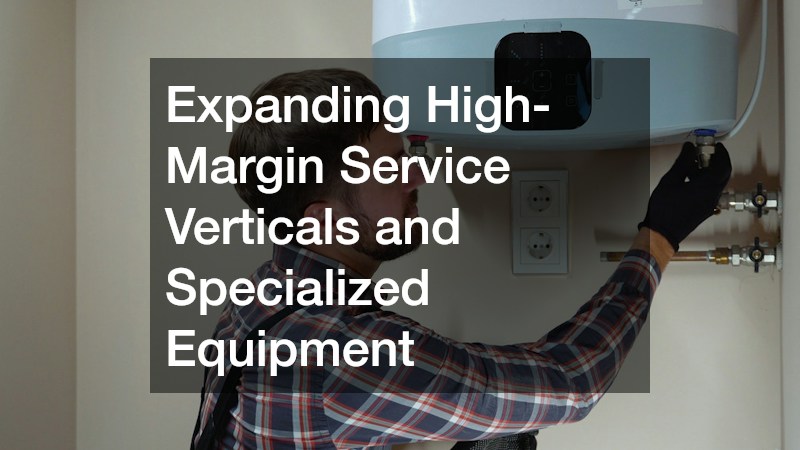
While basic maintenance tasks and fixture installations provide steady daily call volume, relying exclusively on minor service jobs limits long-term revenue growth. To scale efficiently, a trade business must expand its technical service offerings into complex, high-ticket mechanical verticals that yield higher profit margins and require specialized technical expertise.
Diversifying your service menu into advanced heating, hydronic, and water treatment systems establishes your business as a full-service mechanical authority while dramatically raising your average revenue per service call.
Developing internal expertise in complex residential and commercial mechanical equipment protects your company during economic swings.
- Hydronic and Boiler System Maintenance: Train senior field technicians to diagnose, service, and install high-efficiency radiant heating systems and commercial hydronic setups, positioning your fleet to capture lucrative winter emergency calls for boiler repairs.
- Proactive System Replacements: Establish diagnostic replacement protocols to identify aging, rusted, or inefficient domestic hot water tanks during routine house visits, giving homeowners clear replacement options before catastrophic tank leaks occur.
- Heat Pump and Tankless Conversion Sales: Offer modern, eco-friendly tankless water heating upgrades alongside standard unit replacements, turning low-margin service calls into high-value mechanical upgrades that deliver long-term energy savings to the client.
- Third-Party Consumer Financing Options: Partner with national trade financing providers to offer flexible monthly payment plans for major system replacements, enabling homeowners to approve comprehensive water heater repairs or complete mechanical overhauls without delay.
Dominating Local Drain Services and Subterranean Infrastructure
Another essential pillar of sustainable growth is capturing market share in subterranean wastewater management and drain restoration services. Drain issues represent some of the most frequent, urgent emergency calls homeowners make. However, many small service businesses limit their earning potential by treating mainline drain clearing as a simple, low-cost rod-out service.
Investing in advanced diagnostic and sewer restoration technology transforms routine emergency calls into major trenchless infrastructure replacement projects.
- Mandatory HD Camera Inspections: Require field technicians to run high-definition, self-leveling sewer cameras down every cleared line to provide homeowners with clear video proof of root intrusion, cracked clay pipes, or collapsed sub-surface lines.
- Hydro-Jetting Equipment Deployment: Utilize trailer-mounted or portable commercial hydro-jetting units to scour grease, mineral scale, and tree roots from lines completely, offering long-term pipe cleaning guarantees that basic drain snakes cannot match.
- Trenchless Pipe Rehabilitation: Expand your operational capabilities to include non-invasive Cured-In-Place Pipe (CIPP) lining and pipe bursting techniques, allowing your crews to rehabilitate damaged underground sewer pipes without destroying customer lawns, driveways, or landscaping.
- Specialized Fleet Allocation: Build dedicated drain-clearing service trucks staffed by specialized technicians to handle high-volume calls for clogged drains efficiently, freeing up your master mechanics to handle complex mechanical installations.
Positioning your company as a complete wastewater solution provider ensures that clients do not turn to third-party drain cleaning companies when major structural pipe repairs are required. Providing end-to-end drain and sewer solutions under one roof maximizes customer retention and drives substantial revenue per technician.
Building Recurring Revenue Streams and Multi-Truck Talent Pipelines
The ultimate barrier to scaling any trade service enterprise is recruiting, training, and retaining qualified technical talent. The skilled labor shortage affects contractors across the country, making it impossible to grow simply by posting job ads for experienced Journeymen or Master mechanics when you need to add a truck.
To build a scalable business, you must construct an internal talent development pipeline while simultaneously establishing recurring service membership revenue to stabilize cash flow year-round.
Developing a culture of continuous learning and predictable service delivery protects your business from seasonal demand drops.
- Build an In-House Training Academy: Establish a dedicated hands-on training facility within your warehouse where apprentices can practice pipe joining, diagnostic troubleshooting, and customer service presentation scripts under senior supervision.
- Define Transparent Career Paths: Provide clear, merit-based advancement frameworks that outline exact technical milestones, certification achievements, and sales benchmarks required for junior team members to advance into senior lead plumbers.
- Institutionalize VIP Service Membership Clubs: Sell annual home maintenance memberships that provide residential clients with annual backflow testing, water heater flushes, system safety audits, and priority dispatch booking.
- Coordinate Niche Service Subcontracting: Establish formal cross-referral arrangements with specialized infrastructure providers—such as coordinating with licensed local septic pumping contractors—to handle rural waste management needs seamlessly without investing in expensive heavy vacuum trucks prematurely.
A robust residential membership program creates an incredible competitive advantage. During quiet seasonal lulls when competitors are struggling to generate service calls, your office can schedule hundreds of pre-paid membership tune-ups, keeping your trucks moving and your field technicians fully billable year-round.
Strategic Leadership Implementation Roadmap
If you are ready to transition your company from a stressful, owner-dependent job into a highly structured, scalable enterprise, follow this quarterly implementation plan:
Quarter 1: Financial Restructuring & Price Optimization
- Audit your historical financial records to calculate your true fully burdened hourly labor cost, including all administrative overhead and truck depreciation.
- Eliminate hourly time-and-materials billing entirely and implement a comprehensive, value-based flat-rate pricing system across all trucks.
- Train field staff on soft skills, professional customer presentation standards, and multi-option job quoting techniques.
- Establish daily and weekly KPI tracking for gross profit margins, average invoice size, and conversion percentages.
Quarter 2: Field Software Integration & Operations
- Transition your dispatch, customer booking, and billing workflows to an enterprise cloud Field Service Management platform.
- Standardize vehicle stocking manifests across your fleet to ensure uniform parts inventory on every service van.
- Implement automated SMS arrival notifications, mobile point-of-sale credit card processing, and digital customer review requests.
- Set up geographic zone dispatching to minimize driver travel time and fuel costs.
Quarter 3: Service Expansion & High-Margin Verticals
- Invest in advanced diagnostic equipment, including commercial hydro-jetting units and self-leveling HD sewer inspection cameras.
- Launch dedicated high-margin service initiatives focused on tankless conversions, boiler maintenance, and specialized pipe rehabilitation.
- Establish strategic relationships with third-party consumer financing providers to offer low monthly payment options for major system replacements.
- Train field crews to run mandatory camera inspections on all mainline blockage calls to identify major restoration opportunities.
Quarter 4: Talent Academy & Membership Launch
- Design an internal training facility and structure a formal apprenticeship program to develop technicians in-house.
- Launch a structured residential VIP Service Club membership program to generate predictable recurring revenue.
- Create transparent, performance-based career advancement tracks for all technical and administrative employees.
- Conduct annual financial reviews to evaluate net profit margins, adjust price book line items, and plan fleet vehicle additions for the upcoming year.
Scaling a service company successfully is not about working harder or spending more exhausted hours behind the wheel of a service van. True growth is achieved by building robust operational systems, empowering your team with modern technology, and enforcing rigorous financial discipline across every department. When you replace ad-hoc daily decisions with standardized workflows, you eliminate the operational bottlenecks that keep so many business owners trapped in daily firefighting mode.
By building a value-based flat-rate pricing structure, digitizing dispatch management, expanding into high-ticket mechanical verticals, and cultivating talent from within through a structured apprenticeship academy, you create a business model engineered for long-term expansion. Take control of your company’s future today. Audit your operational pricing, implement standardized field systems, and execute a strategy that turns your business into a profitable, self-sustaining enterprise!